Home prices rebound

By Chris Isidore @CNNMoney September 25, 2012: 10:11 AM ET

Home prices are back to 2003 levels in the latest sign of an improved housing market.

NEW YORK (CNNMoney) — In another sign of a turnaround in the long-battered real estate market, average home prices rebounded in July to the same level as they were nine years ago.

According to the closely watched S&P/Case-Shiller national home price index, which covers more than 80% of the housing market in the United States, the typical home price in July rose 1.6% compared to the previous month.

It marked the third straight month that prices in all 20 major markets followed by the index improved, and it would have been the fourth straight month of improvement across the full spectrum if not for a slight decline in Detroit in April.

The index was up 1.2% compared to a year earlier, an improvement from the year-over-year change reported for June. While home prices have been showing a sequential change in recent months, it wasn’t until June that prices were higher than a year earlier.

The July reading matched levels last seen in summer 2003, when the market was marching toward its peak in 2006. The collapse of the market after that led to the financial crisis of 2008.

“The news on home prices in this report confirm recent good news about housing,” said David Blitzer, Chairman of the Index Committee at S&P Dow Jones Indices. “Single-family housing starts are well ahead of last year’s pace, existing home sales are up, the inventory of homes for sale is down and foreclosure activity is slowing.”

Record low mortgage rates and a tighter supply of homes available for sale have helped to lift home prices. Lower unemployment also has helped with home prices, although job growth in recent months has been slower than hoped.

Earlier this month, the Federal Reserve announced it would buy $40 billion in mortgage bonds a month for the foreseeable future. This third round of asset purchases by the central bank, popularly known as QE3, is its effort to jump start the economy through even lower home loan rates.

Related: Best home deals in Best Places

Mike Larson, real estate analyst with Weiss Research, said part of the improvement in the housing market is due to investors using the low mortgage rates to buy up homes that are in foreclosure and renting them in a strong rental market.

But he said that he doesn’t think there’s much chance of housing prices forming any kind of new bubble in the foreseeable future.

“Clearly the worst is behind us for this market., but this is not a market that is going to take off again,” he said. “While you have a firming up, you still have tight lending standards and people who have been burned are reluctant or unable to get back in the market.” He predicts it will take several more years before housing prices can gain more than 1% to 2% a year.

Related: Buy or rent? 10 major cities

But that is good news for a housing market that was plagued by plunging home values and high foreclosure rates for much of the last six years. And the good news has the potential to build on itself, said Joseph LaVorgna, chief U.S. economist for Deutsche Bank.

“Housing remains a rare bright spot in an economy that is otherwise muddling through,” he wrote in a note to clients Tuesday. “The price trend for housing is significant, because it provides economic stimulus via stronger household balance sheets.”

Correction: An earlier version of this article incorrectly reported that home prices had reached a 9-year high. In fact, they rebounded to the level last seen in summer 2003, before their peak several years later. To top of page

COURTESY OF YOUR NUMBER ONE ARCADIA REAL ESTATE AGENT

The Door Is Now Open to Home Builders

Housing is hot again.

[image]

It was a sign of renewed investor enthusiasm last week when real-estate-information firm Trulia Inc.’s TRLA -4.04% share price rose more than 40% on Thursday following its initial public offering. So was the surge Friday in KB Home KBH +16.40% shares after KB reported an unexpected quarterly profit. Although home prices turned the corner just this past spring, shares of home builders have more than tripled on average since their 2009 nadir.

Next up is Lennar Corp., LEN +2.49% which is slated to report fiscal third-quarter earnings Monday. Analysts expect earnings of 28 cents a share for the period ending in August, up sharply from 11 cents a year earlier.

For a while this spring it was possible to debate whether the long-awaited turn had come in house prices, as some measures turned positive while the widely followed S&P/Case-Shiller Home Price Index lagged behind. Now that measure, due Tuesday, is pointing up as well, although its originator, Robert Shiller, says he isn’t convinced we have hit the bottom yet.

In any case, there is cause for at least short-term cheer, particularly for home builders that rallied after last week’s housing-starts data. Single-family housing starts rose at the quickest pace since April 2010—a period artificially boosted by a tax credit for first-time home buyers. Lennar’s share price broke above $37 Friday for the first time since June 2007, ending at $38. Is it deserved? In its last reported quarter, the company sold 3,222 houses, up 20% year on year. But in 2006 it sold nearly 50,000 in a year. Even though its operating margin nearly doubled to 9.2% in the second quarter, that is still shy of the mid-to-low teens Lennar enjoyed in its heyday.

image

Bloomberg NewsKB Home shares surge Friday after the company reported an unexpected quarterly profit.

In a way, that is encouraging, because there should be more upside even with the stock trading at nearly 27 times 2013 earnings estimates. Housing starts have slumped mightily since their peak, and pent-up demand is significant. Between 1992 and 2007, single-family starts averaged nearly 1.3 million a year, while they averaged just 500,000 the following four years. The Fed’s recent steps to further boost housing by buying mortgage-backed securities bode well, too.

While not home-free, home builders have given investors some grounds to justify recent gains.

By Spencer Jakab

COURTESY OF YOUR NUMBER ONE ARCADIA REAL ESTATE AGENT

Can You Afford to Buy a Second Home?

By Jeff Brown
With more and more signs that the housing market is inching off the bottom, homeowners with good credit and lots of resourcesare once again asking the question: Can I afford a second home?There’s something irresistible about the dream of a vacation place at the beach, lake or in the mountains. Summer vacations, the clan gathering for holidays, a place to pass down through the generations… It’s the American Dream, Act II.

The problem, of course, is coming up with the money. If you don’t have a trunk full of cash, the next easiest option is to borrow against your primary residence, thus avoiding the complex issues raised by a loan application specifically to buy a second home. But to borrow against your main home, it must be worth substantially more than you owe on a mortgage or home equity loan.

To take out a new loan to buy a second home you will have to convince the lender you are an especially good risk. That’s because lenders know that people are more likely to default on payments for a second home than a primary residence, or to skimp on maintenance or fall behind on property taxes or insurance.

So the first issue is your debt-to-income ratio, figured by dividing your total monthly debt payments for everything — existing mortgage, the new mortgage, car and credit card payments, and so on — by your gross monthly income. If the figure is less than 36 percent, you have a fair shot at a loan, if your payment history and credit rating are good. Some lenders will approve applicants with higher ratios; you’ll have to shop around.

Also expect lenders to demand a down payment of at least 20 percent, possibly twice that much, or even more. A large down payment reduces the loan-to-value ratio, figured by dividing the loan amount by the property’s current value, estimated by an appraiser approved by the lender. The smaller the loan relative to the value, the more likely the lender would recover what it is owed if you default and the lender must foreclose and sell the property.

You’re also likely to pay a higher interest rate on a mortgage for a second home — again, to offset the greater risk to the lender.

Discouraged yet? Don’t be. After all, even if lenders are more conservative these days, they make money only if they approve loans.

To make all this easier, try this calculator from The Mortgage Professor website. In the Occupancy Type window click Second Home. Note that in the Monthly Debt Payments window you should include your current mortgage payment if you will add a new mortgage for the second home.

Also play with this calculator from SmartMoney.

Before going too far down the road, check with some lenders for down payment requirementsand interest rates on second-home loans. Until then, experiment with down payments of 20 percent, 30 percent and 40 percent, and add 0.5 to 1 percentage points to the mortgage rates from the Bankingmyway.com survey.

For a sense of how lenders approach second-home applications, look at this site from Wells Fargo. It shows, for example, that it is difficult to get potential rental income included in the loan qualification calculation, a key consideration if you plan to rent out your second home part of the time.

Even if a lender will approve your loan, think about how comfortable you would be with this new financial obligation. You’ll need a healthy financial cushion for unexpected repairs and upkeep, a drop in your pay, a shortfall in rental income or a jump in taxes or insurance fees.

Finally, give your dream a reality check. Many people find, for example, that they lose interest in vacationing at the same place all the time. And a second home can someday become a bone of contention among the buyer’s children or grandchildren.

COURTESY OF YOUR NUMBER ONE ARCADIA REAL ESTATE AGENT

Regulator Vows New Rules to Repair Mortgage Markets

In a move aimed at making it easier for consumers to get mortgages, the federal regulator for Fannie Mae and Freddie Mac FMCC -2.12% said Monday the mortgage giants would address a big controversy of the housing bust: who gets stuck with bad loans.

Fannie and Freddie have forced banks to repurchase billions of mortgages that have defaulted over the past few years. To protect themselves from facing similar demands, banks have raised their lending standards beyond what the two mortgage companies require, scrutinized appraisals, and demanded extensive documentation of a borrower’s income and assets.

image

ReutersA bank-owned home for sale in Encinitas, Calif., in a file photo from 2009.

To ease lenders’ concerns, the Federal Housing Finance Agency said on Monday it would issue guidance that would detail steps that could limit their risk of having to buy back defaulted mortgages in costly loan “put-backs.”

For example, banks will be released from having to buy back a loan under certain conditions if the mortgage has a record of on-time payments for the first 36 months, or for the first 12 months on loans that are part of an existing refinancing initiative. Those changes will take effect next year.

It isn’t clear how far the latest guidance will go toward making it easier for consumers to get a mortgage. While mortgage rates have fallen by a full percentage point over the last 18 months, demand for new loans remains nearly unchanged from one year ago.

“For the market to reclaim the strength it once had—and to provide a cornerstone for the mortgage market of the future—it is vital we consider ways to improve” the loan review process, Edward DeMarco, the acting director of the Federal Housing Finance Agency, told an industry conference Monday.

Fannie and Freddie don’t make loans, but instead acquire or guarantee those made by banks and other lenders. Those banks make certain “representations and warranties” to Fannie and Freddie when they sell loans, and the mortgage giants can force banks to take back any loans found to run afoul of those standards. Over the past year, banks have charged that Fannie and Freddie are putting back more loans that defaulted for reasons that had nothing to do with an underwriting defect.

Fannie and Freddie have asked that banks buy back nearly $75 billion in loans that lenders sold to the mortgage giants since 2005, according to Inside Mortgage Finance, an industry newsletter.

The new rules won’t have any impact on the current battle over who winds up with the bad loans made during the boom years.

In exchange for shielding banks against put-backs on certain loans, Fannie and Freddie will step up screening for potential loan defects of new mortgages. Officials said Monday that a more robust data-collection system implemented in recent years has made it possible to increasingly review loans as they are acquired, as opposed to reviewing them after they default.

Because buying back one bad loan can wipe out the profit on 30 or 40 good loans, lenders have become extremely cautious in approving mortgages. “If there’s a question at some point, it’s the safer move to deny” the loan, said Bob Walters, chief economist at Quicken Loans.

An April survey of senior loan officers by the Federal Reserve showed that the risk of put-backs had become a leading factor preventing banks from easing credit standards for mortgages, even as they have eased standards for other loans, such as cars and credit cards.

“Lenders have pulled back because they don’t know what their future exposure around repurchases is going to be…. Ultimately that has limited the availability of mortgage credit,” said Maria Fernandez, associate director for housing and regulatory policy at the FHFA.

The agency’s goal, she added, “is to be very clear with lenders what our expectations are so we can help facilitate more liquidity.”

Industry analysts said the impact of the new rules would rest largely on the details of the rules issued by Fannie and Freddie, and how they enforce those rules. “If you have written guidance from these quasi-government agencies what their terms are, they can’t really walk away from that,” said Laurence Platt, a banking-industry lawyer at K&L Gates in Washington.

At the same time, banks face new regulation in the coming year that could keep them in a defensive position. One provision of the Dodd-Frank financial-overhaul law, for example, carries potentially steep penalties if banks don’t properly ensure a borrower has the capacity to repay a loan.

Some large banks are also facing subpoenas from federal prosecutors as part of an effort by the FHFA’s inspector general to determine whether the U.S. could recoup money from banks that sold defaulted loans to Fannie and Freddie, according to people familiar with the investigation.

“It’s one step forward, two steps back,” said Mr. Platt. “You have a bunch of different legs that aren’t walking in unison.”

By NICK TIMIRAOS

COURTESY OF YOUR NUMBER ONE ARCADIA REAL ESTATE AGENT

Buying beats renting in most U.S. cities

By Les Christie @CNNMoney August 2, 2012: 11:10 AM

Buying  a home in most major markets will end up being cheaper than renting one.
Buying a home in most major markets will end up being cheaper than renting one.

NEW YORK (CNNMoney) — For people who are willing to stay put for a few years, buying a home has become a much better deal than renting in almost every major housing market in the nation.

In more than 75% of the 200 metro areas analyzed by real estate listing web site Zillow, homeowners would reach a “breakeven point” — where owning the home makes better financial sense than renting it — in three years or less.

“Historic levels of affordability make buying a home a better decision than ever, especially considering rents have risen more than 5% over the past year,” said Stan Humphries, chief economist for Zillow.

The survey was Zillow’s first buy-versus-rent analysis, incorporating all homeownership costs, including down payments, closing costs, mortgage payments, property taxes, utilities and maintenance costs, and compared them to rental costs. It also took into account projected home price appreciation and rent increases, as well as tax deductions and inflation.

Zillow’s findings support other reports that show that rising rents, record-low mortgage rates and falling home prices have made homeownership a more attractive option.

In some of the metro areas Zillow looked at, home buyers would break even in less than two years.

In Miami, for example, a homebuyer would only have to stay in their home for about 1.6 years for the purchase to pay off, Zillow said.

Homes in the metro area are selling for about 45% less than they were five years ago. Meanwhile, over the past three years, rents have climbed 20%, according to RentJungle.

Miami’s metro area, along with Tampa, Fla., Memphis, Tenn., and several smaller cities, have the shortest break-even times of the markets Zillow analyzed.

Renters still have the upper hand in some cities. It would take home buyers in San Jose, Calif., 8.3 years to break even on their homes — the longest period of time of any of the metro areas Zillow surveyed. Other big cities where buying was not such a good a deal were Honolulu, at a six-year break-even point, and San Francisco at 5.9 years. To top of page

Buy vs. rent in 30 major cities
City State Breakeven time in years
New York N.Y. 5.1
Los Angeles Calif. 4.3
Chicago Ill. 2.8
Dallas Texas 2.1
Philadelphia Pa. 3
Washington D.C. 3.5
Miami Fla. 1.6
Atlanta Ga. 2.5
Boston Mass. 4.3
San Francisco Calif. 5.9
Detroit Mich. 1.7
Riverside Calif. 2
Phoenix Ariz 1.7
Seattle Wash. 4
Minneapolis Minn. 2.7
San Diego Calif. 3.6
Tampa Fla. 1.6
St. Louis Mo. 2.5
Baltimore Md. 2.8
Denver Colo. 2.5
Pittsburgh Pa. 2.1
Portland Ore. 3.5
Sacramento Calif. 3.1
Orlando Fla. 1.7
Cincinnati Ohio 2.1
Cleveland Ohio 2.4
Las Vegas Nev. 1.7
San Jose Calif. 8.3
Columbus Ohio 2.4
Charlotte N.C. 2.7
Source: Zillow

COURTESY OF YOUR NUMBER ONE ARCADIA REAL ESTATE AGENT

Growing Panes: Homeowners Go Big on Glass Walls

Anita and Bob Dethlefs wanted the new Portland, Ore. home they were building to really let the sunshine in. So, the couple installed 2,700 square feet of Marvin windows—about $300,000 worth—on nearly every wall of the property.

Giant spans of glass,once seen mainly in commercial construction, are now more common in residential homes. Wendy Bounds explains how technology has enabled glass makers to make these more affordable, safe (if tempered) and energy efficient.

And then they put up 12 security cameras.

“We’re getting about as much light as you can in the Northwest but with so many windows, safety was the No. 1 concern for me as a mommy with kids running around the house,” says 43-year-old Ms. Dethlefs, who has five children. Her husband started a leadership conference business, Evanta Inc., in 2003 and later sold it. Their 13,000-square-foot, $5 million Frank Lloyd Wright-inspired home even has a glass front door, letting visitors on the front stoop see through the family’s living room out to Mount Hood.

Forget about a room with a view. Today, homeowners want views from every room. As large expanses of glass have become architecturally acceptable for modern and traditional homes, new technology is making living in a fishbowl more practical—albeit sometimes challenging.

Homes That Let the Sun Shine In

Leah Nash for The Wall Street Journal

Anita and Bob Dethlefs moved into their new Portland 13,000-square-foot home in November. The Frank Lloyd Wright-inspired home has about $300,000 worth of windows to let in as much light as possible and help with the ‘gray sky’ malaise Ms. Dethlefs says she gets living in the Pacific Northwest.

Homeowners’ desire for more open floor plans with combined kitchen and living-room spaces has paved the way structurally for bigger spreads of glass. A growing appetite for more energy-efficient windows and associated tax incentives and rebates have also supported the trend.

“The open floor plan is predominant in almost everyone’s design now,” says builder Tim Wilkinson of Great Falls, Mont. “They want more light and bigger windows to take advantage of views.”

Today, thanks to technological advances, nearly all windows installed in new homes have special, invisible coatings that block heat and keep ultraviolet rays from fading furniture. Many also use double or triple-panes with argon or krypton gas sandwiched in between, which helps insulate in cold climates. Now standard on Andersen Windows glass: a titanium dioxide coating the company says sheds dirt and virtually eliminates water spots. Some glass makers are even marketing windows for residences that can tint and untint with the push of a button.

And for those put off by the prospect of raising and lowering so many blinds, companies such as Lutron Electronics sell window shades that can be controlled with an iPhone app.

“Across the board, people want more light,” says Mike Rogers, senior vice president of GreenHomes America Inc., a company specializing in energy-efficient home renovations, which has been incorporating more glass in its projects.

Beyond privacy and safety—Ms. Dethlefs’s chief worries—there are maintenance issues, such as how to keep so much glass spotless. (The couple pay $850 to $950 for professional cleaning at least three times a year.) And despite technological improvements, glass still doesn’t typically insulate as well as a wall packed with insulation.

Then there is the bird problem: Anywhere from 100 million to 1 billion are killed in window collisions every year, according to the U.S. Fish and Wildlife Service.

While manufacturers such as Andersen Corp. and Marvin Windows and Doors say overall window sales have slowed amid a sluggish new-house market, the companies say they are seeing more and larger windows going into new homes.

In modern homes, “they are filling space between floor and ceiling with as much glass as they can,” says Jay Sandgren, an architectural representative for Andersen. He says builders are being “a lot smarter” about positioning a home and the roof overhang to capture the most sunlight in winter and to block much of the heat from the sun in summer.

Building with glass isn’t cheap. Mr. Wilkinson the Montana builder estimates the price is about double the cost of installing regular walls packed with insulation. His own 4,800-square-foot home that he completed last year has $85,000 worth of Andersen glass, giving him a 240-degree view of three mountain ranges and the Missouri River. Even the deck railings are glass panels.

Tempered safety glass is installed according to local building codes in areas of homes where breakage might be of particular concern, such as windows and doors close to the floor or near a stairway or landing. Glass can sometimes attract vandals in the construction phase, a headache for builders, Mr. Wilkinson says. But breakage for homeowners “is rarely a problem,” he says, although he cautions that people mowing the lawn should look out for rocks that the mower can kick out to crack a pane.

Architect Thomas Roszak took the fishbowl aesthetic to the extreme in his own Northfield, Ill. home, which features commercial curtain-wall glass around the entire building.The walls are constructed from two argon-filled glass panes covered with what’s called low-emissivity, or “low-e,” metallic coating to block heat flow through the window, keeping the home cooler in the summer and warmer in winter.

With little traditional wall space, art is suspended in front of windows from a floor-to-ceiling, museum-type wire hanging system, Mr. Roszak says. For privacy, he planted trees around his one-acre property and installed $60,000 worth of electronically operated blinds.

One low point of glass-house design: The day his 8-year-old son spied a dead bird that had hit home’s glass siding, likely mistaking the trees’ reflection for safe habitat. “He said, ‘Daddy, I don’t think that bird is sleeping, I think it’s broken,'” Mr. Roszak says.

Glass homeowners must be mindful of clutter, since the view goes both ways. When Beata and Brad Peters built their 3,900-square-foot brick home in Hawthorn Woods, Ill., they incorporated large panels of glass symmetrically throughout. While most windows have wood blinds, the family tends to leave them open for aesthetics.

“I don’t put a lot of stuff in front of the windows,” Ms. Peters says. In the kitchen, appliances like toasters get packed along a wall with no glass.

Window-treatment companies are pushing to make shade operation less of a chore. Rotterdam-based Hunter Douglas this spring added a “Solar Energy Sensor” that raises and lowers blinds based on the amount of sun detected. Despite the slump in the housing market, the company’s North American sales rose almost 5% last year. An electronically controlled Lutron shade sells for about $900 more than manual ones and can be controlled via remote control or an app for Apple Inc. or Android devices.

Some glass companies now make windows that reduce the need for blinds altogether. One is Sage Electrochromics Inc. of Faribault, Minn., whose product consists of clear panes that morph to a grayish-blue tint when a user flips a switch to send a low-voltage current across the window. The tint reduces glare and heat but not visibility. Sage began selling the glass for residential applications around 2005, though they are typically found in high-end homes due to cost. An installed window costs between one-and-a-half to two times as much as one with typical low-e glass.

“If you’re on the West Coast facing the ocean when the sun is beating on the glass, what people do is pull their blinds and shades to block the glare,” says Helen Sanders, Sage’s vice president of technical business development. “What that means is you’ve just lost your view you paid a huge amount of money for.”

I hope you enjoyed the article! –

COURTESY OF YOUR NUMBER ONE ARCADIA REAL ESTATE AGENT

Joel Schumacher Lists California Estate for $9.5 Million


Filmmaker Joel Schumacher has listed his Carpinteria, Calif., home for $9.5 million. Candace Jackson has details on The News Hub. Photo: Jim Bartsch.

Filmmaker Joel Schumacher has listed his 7-acre Carpinteria, Calif., estate for $9.5 million.

Photos

Jim BartschFilmmaker Joel Schumacher has listed his 7-acre Carpinteria, Calif., estate for $9.5 million.

Just outside of Santa Barbara, the compound was built by Mr. Schumacher on four separate parcels and includes a 6,500-square-foot main house with three bedrooms. Built in 2000, it has both mountain and ocean views and was built in a modern-rustic style with reclaimed barn wood. The home’s large living room has vaulted ceilings, two fireplaces and a loft currently configured as an office. A rotunda-shaped dining room has large windows overlooking a swimming pool. The master suite has a fireplace and a terrace.

The property also includes a guesthouse and a home for a property manager, each of which has two bedrooms and two bathrooms, and a pool house.

Known for such movies as “Batman Forever” and “A Time to Kill,” Mr. Schumacher is selling because he’s no longer using the property as much as he used to, according to a listing agent.

Rebecca Riskin & Associates is handling the listing.

A Miami, Fla., home has re-listed for $19 million, up from an original list price of $16.5 million. The seller is Dean Ziff, a private investor whose family founded and owned SunglassHut retail stores. Candace Jackson has details on The News Hub. Photo: Sotheby’s International Realty.

Miami Home Relists and Ups Its Price by 15% to $19 Million

A Miami home has relisted for $19 million, up from an original list price of $16.5 million. The seller is Dean Ziff, a private investor whose family founded and owned Sunglass Hut retail stores.

Built in 1990, the home is on 2½ acres of waterfront along Biscayne Bay. Located in a neighborhood with 24-hour security, the property is surrounded by tropical landscaping. The 14,400-square-foot main house, with Colonial Colombian architectural influences, has eight bedrooms and 10 bathrooms. The home is built around a central atrium, and includes a large master suite and a second-story loggia overlooking the water.

Outside, there’s a swimming pool with an island in the middle and a tennis court. There are also two one-bedroom casitas and a guesthouse with its own kitchen and living room.

The home’s listing agent, Mayi de la Vega of Sotheby’s International Realty, says the listing price was raised because home underwent restorations and updates when it was taken off the market. She shares the listing with Jorge Uribe, also of Sotheby’s.

A Southampton, N.Y. home has listed for $30 million. On more than five acres, the property is directly on the beach with about 200 feet of oceanfront. It includes a two-story, 5,000-square-foot contemporary home with five bedrooms and six bathrooms. Candace Jackson has details on The News Hub. Photo: Philip M. Stamm.

A Home in the Hamptons Lists for $30 Million

A Southampton, N.Y., home has listed for $30 million.

On more than 5 acres, the property is directly on the beach with about 200 feet of oceanfront. It includes a two-story, 5,000-square-foot contemporary home with five bedrooms and six bathrooms. The two-story home has two kitchens, one on each level. There’s a swimming pool surrounded by a glass atrium. It also has a gated entry and a tennis court.

Philip Stamm, an attorney for the owner, whom he described as an 83-year-old relative, says the owner is selling because he has had the property for more than 25 years and is looking to move on. Mr. Stamm is handling the listing; Ryan Podskoch and Matt Podskoch of Global Real Estate Network are also marketing the property.

—Candace Jackson—Email: privateproperties@wsj.com

A version of this article appeared July 27, 2012, on page D8 in the U.S. edition of The Wall Street Journal, with the headline: Private Properties.

I hope you enjoyed the article! –

COURTESY OF YOUR NUMBER ONE ARCADIA REAL ESTATE AGENT

The Top 5 Things Buyers Love

The Top 5 Things Buyers Love

This week’s blogs are chock-full of ways to translate what buyers love into strategies for selling your home this spring. 
Here are the top five things potential buyers want in a brand-new house, according to a recent survey by trade publisher Hanley Wood:
  • Everything is new
  • Less maintenance
  • More energy-efficient
  • Opportunity to customize
  • Contemporary floor plan

And here are the top five things potential buyers like about existing homes:

  • More affordable
  • Established community
  • Opportunity to remodel
  • Character
  • Better neighborhood

Now you know what to emphasize in your listing, whether you are selling a new house or an existing house.

Image courtesy of Morguefile contributor Taliesin

COURTESY OF YOUR NUMBER ONE ARCADIA REAL ESTATE AGENT

Rosenthal Wine Estate in Malibu Is Listed for $59.5 Million


A 235-acre Malibu, Calif. wine estate has listed for $59.5 million. Candace Jackson has details on Lunch Break. (Photo: Simon Berlyn)

A 235-acre Malibu, Calif., wine estate has listed for $59.5 million. The seller is George I. Rosenthal, the chairman of Raleigh Enterprise, which owns and operates commercial real estate, hotels, and movie and TV studio complexes.

Mr. Rosenthal assembled the Rosenthal Wine Estate beginning in 1977. The property includes a 12,000-square-foot hacienda-style main residence with two swimming pools. There are also horse stables and two guesthouses, including one with an additional pool.

Photos: Private Properties

Nick SpringettA 235-acre Malibu, Calif., wine estate has listed for $59.5 million. The main house has two swimming pools.

The property includes 25 acres of hillside vineyards as well as a wine-tasting room, banquet room and office. The home’s furnishings are included in the purchase price.

“It’s been a great joy in my life but it’s time to take on other things,” says Mr. Rosenthal. His 90-acre Aspen, Colo., property, known as Jigsaw Ranch, is also on the market in two separate parcels, one asking $36 million and the other $22 million.

Irene Dazzan-Palmer and Sandro Dazzan of Coldwell Banker Previews International have the Malibu listing. Joshua Saslove of Joshua & Co. has the Aspen listings.

Former Congressman William Stuckey has listed his Washington, D.C. home for $6.25 million. Candace Jackson has details The News Hub. (Photo: Tom Schweda/Matt and Ryan Podskoch Global Real Estate Network)

Williamson Stuckey Asks $6.25 Million for Washington, D.C., Home

Former Rep. Williamson Stuckey and his wife, Ethelynn, have listed their Washington, D.C., home for $6.25 million.

Located on an acre in the Spring Valley neighborhood, the 8,000-square-foot house has six bedrooms and seven bathrooms. The 1920s-era home has a stone exterior and a slate roof, and there are extensive gardens. Inside, there’s a large dining room, a sunroom and a library. The home was extensively renovated and updated in 2006, though the original windows and exterior features were kept intact.

Mr. Stuckey, who is the chairman of Stuckey’s, a large chain of highway rest stops, purchased the home with his wife 45 years ago from then-Commerce Secretary John T. Connor. According to Mrs. Stuckey, Mr. Connor told Mr. Stuckey about the home over dinner at the White House and he decided then to buy it. They paid about $180,000 for it, says Mrs. Stuckey.

Mrs. Stuckey says they are selling because they plan to return to Georgia, where they are from. “I really have a lot of my heart in the house and the garden,” she said. Cathie Gill of Cathie Gill Inc. Realtors has the listing.

An Evergreen, Colo. home has listed for $18.95 million. Candace Jackson has details on The News Hub. (Photo: Cathie Gill, Inc./HomeVisit)

Home on 160 Acres Near Denver Is Listed for $18.95 Million

An Evergreen, Colo., home has listed for $18.95 million.

The property, about 40 minutes from downtown Denver, includes 160 acres on five separate parcels adjacent to a national forest. It includes a 9,500-square-foot stone and stucco main house, a 3,000-square-foot caretaker’s residence and two barns. The main house has a terrace along the back with mountain views.

The seller is Robert Truscheit, the owner of a private investment firm, who is based in Washington state. Mr. Truscheit assembled the property in 2004 and built the home in 2009. “Admittedly, it’s a high price,” says Mr. Truscheit. “The right person has to come along who wants the privacy.” Matt Podskoch and Ryan Podskoch of Global Real Estate Network have the listing.

—Candace Jackson—Email: privateproperties@wsj.com.

Corrections & Amplifications
Former Rep. Williamson Stuckey’s first name was incorrectly given as William in an earlier version of this article.

COURTESY OF YOUR NUMBER ONE ARCADIA REAL ESTATE AGENT

FHA’s Mortgage Delinquencies Soar

Closer to a bailout? FHA’s mortgage delinquencies soar

By Tami Luhby @CNNMoney July 9, 2012: 12:38 PM ET

Delinquencies and foreclosures of FHA-backed mortgages are soaring, putting further strain on the housing agency's finances and making a taxpayer bailout more likely.Delinquencies and foreclosures of FHA-backed mortgages are soaring, putting further strain on the housing agency’s finances and making a taxpayer bailout more likely.

NEW YORK (CNNMoney) — The mortgage market appears to finally be stabilizing — as long as you ignore loans backed by the Federal Housing Administration.

Increasingly, FHA-insured loans are falling into foreclosure or serious delinquency, moving in the opposite direction of loans guaranteed by Fannie Mae and Freddie Mac or those held by banks, which are all showing signs of improvement.

And taxpayers could ultimately be on the hook for FHA’s growing number of troubled mortgages. The agency’s finances are already on shaky ground, and additional losses from loans going sour could prompt the need for a federal bailout, experts said.

“We can’t escape this one,” said Joseph Gyourko, a real estate professor at the University of Pennsylvania’s Wharton School. “This is an arm of the U.S. government.”

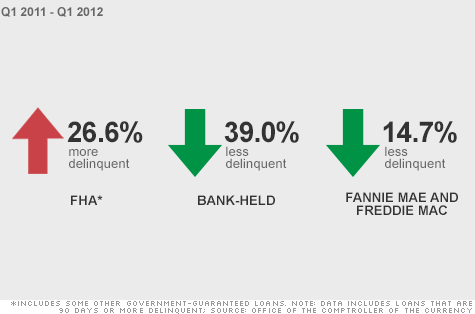
The share of government-guaranteed loans, a majority of which are backed by FHA, that were 90 days or more delinquent soared nearly 27% during the year ending March 31. Foreclosures jumped nearly 17%, according to a report published recently by federal regulators.

At the same time, bank loans saw a dramatic improvement, with delinquencies shrinking by 39% and foreclosures declining by nearly 10%. Fannie and Freddie’s portfolio also improved as delinquencies dropped by nearly 15% and foreclosures slid by more than 6%, the quarterly report issued by the Office of the Comptroller of the Currency said.

FHA has also had a tougher time successfully modifying loans. More than 48% of government-guaranteed mortgages re-defaulted 12 months after modification, compared to 36.2% of loans overall, the report said.

FHA’s risky borrowers: FHA doesn’t make loans, but it backstops lenders if borrowers stop paying. With this guarantee in place, banks are more likely to offer mortgages to borrowers with lower credit scores or incomes.

FHA-backed loans made up more than 29% of the market for home purchases in the first quarter of 2012, according to Inside Mortgage Finance, an industry publication.

Housing experts have been warning for years that many FHA-insured loans are not sustainable, especially in these troubled times. That’s particularly concerning because FHA’s share of the market has swelled in recent years as lenders pulled back on providing mortgages that weren’t backed by the government.

One of the main critiques of FHA loans is that they require very low downpayments — a minimum of 3.5%. In an environment where home prices are declining, borrowers can quickly slip underwater and owe more than their property is worth.

“These are very risky loans,” said Ed Pinto, resident fellow at the American Enterprise Institute, a conservative think tank. And loans made in the past three years are “moving into the beginning of the peak delinquency period and they are very big books of business.”

Unless the economy improves significantly over the next few years, FHA will experience even more delinquencies, said Guy Cecala, publisher of Inside Mortgage Finance.

Little room for failure: The dramatic jump in delinquencies comes despite the agency’s efforts to improve the quality of the loans it insures.

Over the past several years, soaring defaults have been eating away atFHA’s emergency reserves, which cover losses on the mortgages it insures. In fiscal 2009, the reserve fund dropped to 0.53% of FHA’s insurance guarantees, well below the 2% ratio mandated by Congress. By late last year, it had fallen to 0.24%.

FHA pledged to shore up its standards and its finances in 2009. The agency has since increased its insurance premiumsestablished minimum credit scores for borrowers, required larger downpayments from those with credit scores below 580 and banned sellers from assisting borrowers with the downpayment. It also created an office of risk management and cracked down on lenders with questionable underwriting processes.

Despite the emergency fund’s diminishing reserves, FHA maintains that its efforts are working. The loans insured starting in 2009 are much higher quality and should lower delinquency levels over time, an FHA official said.

“We expect the new books will continue with their better performance, primarily because of the steps that were put in place,” he said. “And we are benefiting from having more high-credit borrowers.”

Still, FHA watchers warn that the agency doesn’t have much of a cushion against these rising delinquencies and foreclosures. And if the losses grow too great, the agency could need a taxpayer-funded bailout.

The FHA says that its reserves should be restored by 2014 barring a second recession, but outside experts aren’t so sure.

“They are doing very badly … there’s no two ways about it,” said Andrew Caplin, a New York University economics professor who has studied the agency. “Over the next five years, there won’t be enough of an economic recovery to fix FHA’s finances. Not a chance.” To top of page

COURTESY OF YOUR NUMBER ONE ARCADIA REAL ESTATE AGENT