Home prices lowest since 2002

By Jessica Dickler @CNNMoney May 30, 2012: 3:02 PM ET
Home prices hit new lows.
Home prices hit new post-crisis lows in March.

NEW YORK (CNNMoney) — Home prices hit new post-bubble lows in March, according to a report out Tuesday.

Average home prices were down 2.6% from 12 months earlier, according to the S&P/Case-Shiller home price index of 20 major markets. Home prices have not been this low since mid-2002.

“While there has been improvement in some regions, housing prices have not turned,” said David Blitzer, spokesman for S&P.

Although five cities — Atlanta, Chicago, Las Vegas, New York and Portland — saw average home prices hit new lows, that’s an improvement from last month’s report, in which nine cities notched new lows, Blitzer noted.

In 13 of the 20 cities, average home prices fell in March from the year before. Atlanta fared the worst, with home prices down 17.7% year over year. Home prices in Atlanta, Cleveland, Detroit and Las Vegas are all below their January 2000 levels.

Alternatively, Phoenix posted the largest gain, with prices up 6.1% from last year. Other cities showing an uptick included Dallas, Denver and Miami.

Overall, the 20-city composite is down about 35% from its peak in 2006.

Experts say affordable mortgages, combined with much lower home prices, should help to bolster the housing market.

“It’s probably the best time to buy a home in decades,” said Pat Newport, an analyst for IHS Global Insight.

“But the problem is that unless you have good credit, you are probably going to have trouble qualifying for a loan,” he added, referring to overly tight lending conditions.

Last week, a report by the National Association of Realtors showed thathome sales jumped in April. Sales of new homes were also higher in April, according to a separate government report.

“This might be a strong season, but there’s a good chance we’ll continue down for years still,” said Robert Shiller, professor of economics at Yale University. “There’s too much uncertainty.”

Freddie Mac: 30-year fixed mortgage hits new record low at 3.79%

Mortgage ratesFreddie Mac’s McLean, Va., campus. Rates well under 4% continue for 30-year fixed mortgages (Freddie Mac / May17, 2012)
By E. Scott ReckardMay 17, 2012, 7:26 a.m.

OK, maybe it’s not as jaw-dropping as crashing the 5% or the 4% barrier. But Freddie Mac says 30-year mortgage rates have fallen below 3.8% for the first time to average 3.79%, down from a then-record 3.83% a week ago.

The 15-year fixed loan also hit another new low, falling from 3.05% last week to 3.04% this week in Freddie’s latest survey, released Thursday morning.

The start rates on adjustable mortgages rose slightly in the survey, which asks lenders what rates they are quoting to rock-solid borrowers with 20% down payments or equivalent equity in their homes if they are refinancing.

The borrowers would have paid 0.7% of the loan amount on average in upfront fees and discount points to obtain the fixed-rate loans, and slightly less for adjustable-rate loans.

The low rates have been a gift to people refinancing their home loans, a market also driven recently by a revised government program to help people refinance underwater loans.

A Mortgage Bankers Assn. report this week recorded a double-digit jump in applications for replacement mortgages, which now make up three-quarters of all home loan requests.

Home sale contracts declined last month in California

home sales

A worker tapes a window ledge while working on a home in San Diego’s San Elijo Hills community. (Sam Hodgson / Bloomberg / May 22, 2012)

By Alejandro LazoMay 22, 2012, 10:47 a.m.

The number of contracts signed for new home purchases in the Golden State dropped nearly 8% last month as the inventory of homes for sale remained tight, according to a real estate group.

The California Assn. of Real Estate’s home sale index of pending sales declined 7.9% from March, though that was up 11.9% from April 2011. The index is based on the number of contracts signed by potential buyers and is one indicator of where the housing market is headed.

“Inventory constraints could be a contributing factor to lower pending sales,” said LeFrancis Arnold, president of the real estate group. “The tight inventory we’ve been experiencing in the distressed market over the past several months is now spreading.”

Sales overall in the last few months have been better than last year, but real estate agents have complained that they might be better if there were more properties on the market. Investors have snapped up properties vigorously in recent months. Non-distressed sales are also becoming increasingly competitive, real estate agents said.

A separate report by the National Assn. of Realtors said that the number of closed sales nationally were up 3.4% from March and were up 10% from the same month last year.

May 2012 Market Report/Pasadena California

May 2012 Market Report/Pasadena California. For a Market Report in your area please contact me and just say “Market Report …(insert city)” @ BrettanyHarrison@me.com

April property sales were 28, up 33.3% from 21 in April of 2011 and – 17.6% lower than the 34 sales last month.

May 2012 Mid-Month Market Report/Arcadia California

May 2012 Mid-Month Market Report/Arcadia California. For a Market Report in your area please contact me and just say “Market Report …(insert city)” @ BrettanyHarrison@me.com

Foreclosure activity hits lowest level since Q4 2007

RealtyTrac warns distressed-property ‘dam … will eventually burst’

BY INMAN NEWS, THURSDAY, APRIL 12, 2012.

Inman News®

<a href="http://www.shutterstock.com/gallery-449740p1.html">Foreclosed home image</a> via Shutterstock.Foreclosed home image via Shutterstock.

Foreclosure filings hit their lowest level in more than four years in the first quarter, according to a report from foreclosure data aggregator RealtyTrac.

Default notices, scheduled auctions, and bank repossessions were filed on 572,928 properties in the first quarter, or one in every 230 U.S. housing units — the lowest number of filings since fourth-quarter 2007, when 527,740 properties received filings.

Last quarter’s foreclosure activity was down 2 percent from the fourth quarter and 16 percent from first-quarter 2011. March accounted for nearly 38 percent of the quarter’s foreclosure activity, with 198,853 properties receiving filings. That was the lowest monthly total and the first under 200,000 since July 2007, the report said.

On an annual basis, foreclosure activity fell 17 percent in March.

“The low foreclosure numbers in the first quarter are not an indication that the massive reservoir of distressed properties built up over the past few years has somehow miraculously evaporated,” said Brandon Moore, RealtyTrac’s CEO, in a statement.

“There are hairline cracks in the dam, evident in the sizable foreclosure activity increases in judicial foreclosure states over the past several months, along with an increase in foreclosure starts in many judicial and nonjudicial states in March.

“The dam may not burst in the next 30 to 45 days, but it will eventually burst, and everyone downstream should be prepared for that to happen — both in terms of new foreclosure activity and new short-sale activity.”

States that use the nonjudicial foreclosure process lead the nationwide decline in foreclosure activity, RealtyTrac said. Those 24 states and Washington, D.C., saw foreclosure activity drop 8 percent from the fourth quarter and 28 percent from first-quarter 2011.

Several nonjudicial states saw significant year-over-year drops in activity in the first quarter: Arkansas (79 percent), Nevada (62 percent), Washington (55 percent), Arizona (41 percent), Texas (31 percent), and California (21 percent).

By contrast, foreclosure activity rose 8 percent quarter to quarter and 10 percent year over year in the 26 states that mainly use the judicial foreclosure process.

Judicial states that posted some of the biggest annual increases include Indiana (45 percent), Connecticut (38 percent), Massachussetts (26 percent), Florida (26 percent), South Carolina (26 percent), Pennsylvania (23 percent).

Source: RealtyTrac.

Foreclosure starts, which include default notices or scheduled auctions depending on the state, rose for the third straight month in March, up 7 percent from February, though still down 11 percent year over year.

Foreclosure starts increased on a monthly basis in 31 states, with the biggest jumps in Nevada (153 percent), Utah (103 percent), New Jersey (73 percent), Maryland (53 percent), and North Carolina (47 percent).

Nevada posted the nation’s highest foreclosure activity rate last quarter, with one in 95 units receiving a filing — a 62 percent year-over-year drop.

California had the second-highest foreclosure activity rate (1 in 103 units), followed by Arizona (1 in 106 units).

Top 10 states with the highest foreclosure rates

Area Foreclosure rate (Q1 2012)
U.S. 1 in 230 housing units
Nevada 1 in 95
California 1 in 103
Arizona 1 in 106
Georgia 1 in 119
Florida 1 in 123
Illinois 1 in 141
Michigan 1 in 162
Colorado 1 in 191
Utah 1 in 198
Wisconsin 1 in 206

Source: RealtyTrac

California metro areas accounted for 12 of the 20 metros with the highest foreclosure rates in the nationa in the first quarter, including eight of the top 10.

20 U.S. metros with the highest foreclosure rates

Metro area Foreclosure rate (Q1 2012)
Stockton, Calif. 1 in 60 housing units
Modesto, Calif. 1 in 60
Riverside-San Bernardino-Ontario, Calif. 1 in 62
Vallejo-Fairfield, Calif. 1 in 63
Merced, Calif. 1 in 72
Sacramento–Arden-Arcade–Roseville, Calif. 1 in 77
Bakersfield, Calif. 1 in 81
Las Vegas-Paradise, Nev. 1 in 82
Phoenix-Mesa-Scottsdale, Ariz. 1 in 87
Visalia-Porterville, Calif. 1 in 89
Atlanta-Sandy Springs-Marietta, Ga. 1 in 90
Fresno, Calif. 1 in 92
Miami-Fort Lauderdale-Pompano Beach, Fla. 1 in 95
Oxnard-Thousand Oaks-Ventura, Calif. 1 in 97
Orlando-Kissimmee, Fla. 1 in 101
Rockford, Ill. 1 in 104
Chicago-Naperville-Joliet, Ill.-Ind.-Wis. 1 in 107
Chico, Calif. 1 in 111
Prescott, Ariz. 1 in 113
Santa Rosa-Petaluma, Calif. 1 in 113

Source: RealtyTrac.

From start to finish, the foreclosure process took an average of 370 days to complete nationwide, up from 348 days in the fourth quarter — the highest average in the past five years, according to RealtyTrac.

Some key states are seeing foreclosure timelines decrease, however. In California, the average was 320 days, down from 352 days in the fourth quarter.

Colorado, Utah, Massachusetts, Nevada, Michigan and Maryland also saw declines.

The five states with the longest foreclosure timelines were New York (1,056 days), New Jersey (966 days), Florida (861 days), Illinois (628 days), and Maryland (618 days).

The 86 million invisible unemployed

By Annalyn Censky @CNNMoney May 4, 2012: 10:39 AM ET
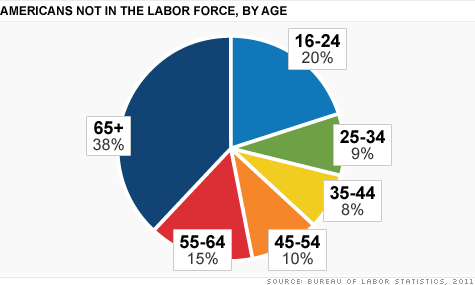
Last year, 86 million Americans were not counted in the labor force because they didn't keep up a regular job search. Most of them were either under age 25 or over age 65.Last year, 86 million Americans were not counted in the labor force because they didn’t keep up a regular job search. Most of them were either under age 25 or over age 65.

NEW YORK (CNNMoney) — There are far more jobless people in the United States than you might think.

While it’s true that the unemployment rate is falling, that doesn’t include the millions of nonworking adults who aren’t even looking for a job anymore. And hiring isn’t strong enough to keep up with population growth.

As a result, the labor force is now at its smallest size since the 1980s when compared to the broader working age population.

“We’ve been getting some job growth and it’s been significant, but it hasn’t yet been strong enough that you start to get people re-engaging in the labor market,” said Keith Hall, a senior research fellow at the Mercatus Center and former commissioner of the Bureau of Labor Statistics.

A person is counted as part of the labor force if they have a job or have looked for one in the last four weeks. As of April, only 63.6% of Americansover the age of 16 fell into that category, according to the Labor Department. That’s the lowest labor force participation rate since 1981.

It’s a worrisome sign for the economy and partly explains why theunemployment rate has been falling recently. Only people looking for work are considered officially unemployed.

Jason Everett, for example, wouldn’t be counted.

Out of work for nearly three years now, Everett has given up his job search altogether.

Instead, the unemployed plumber and Air Force veteran takes a few community college courses and looks after his two children while his wife is the primary breadwinner.

“I’m not even totally convinced the college degree is really going to help at this point, but I figure at least I’ll be doing something,” he said.

The unofficially unemployed

Last year there were 86 million people who didn’t have a job and weren’t consistently looking for one, according to Labor Department data.

Older people, ages 65 and over, account for more than a third. Young people between 16 and 24 make up another fifth. More than half don’t have a college degree and more than two thirds are white.

Many of the teens and 20-somethings may be enrolled in either high school or college full-time. And many of the over 65 crowd are probably retired.

But what about the other 36 million folks who fall in between?

The truth is, the Labor Department simply doesn’t know why they’re not in the labor force. Many may be staying home with children or other relatives. Some may have gone back to school or retraining programs. Others could be disabled and unable to work, and some may have retired early.

“Even in the best of times, there are millions of people who don’t want to work for a variety for reasons,” Hall said.

But he suspects the number of “disengaged” Americans, like Everett, is higher than usual as a direct result of the recession.

About six million people claim they want a job, even though they haven’t looked for one in the last four weeks. If they were to all start applying for work again, the unemployment rate would suddenly shoot up above 11%.

“At this point, the labor market is worse than people realize because people are discouraged. Certainly, a large number of workers have given up on the job market,” Hall said.

That said, the decline in labor force participation is not a new problem. After peaking at 67.3% in early 2000, the rate has been falling ever since.

Researchers at the Chicago Federal Reserve attribute a large part of the decline to the recent recession and lackluster recovery, but the other half to long-term demographic trends.

For example, as more women entered the labor force between the 1960s and 1990s, the participation rate rose rapidly. That effect may have plateaued since then.

Meanwhile, as Baby Boomers entered their prime working years, they also drove the participation rate higher. Once they started hitting their 50s and 60s though, many started transitioning into retirement.

Finally, teenage jobs have been on the decline and college enrollment picked up in the last decade, leading more young people to not be counted in the labor force.

As these trends continue, the Chicago Fed expects the labor force participation rate will keep falling, hitting 62.4% by 2020.

That poses a problem for a variety of reasons.

It hits tax revenue and makes it harder to fund social safety nets like Social Security. Not to mention, it’s likely to increase income inequality.

Most importantly though, it makes the U.S. economy less productive andweighs on growthTo top of page