New to Arcadia or thinking about moving to Arcadia California?


The City of Arcadia extends a warm welcome to you as a new resident of our great city.  Arcadia has a long history of excellence, dedication and community pride.  The City Council and staff are committed to providing the best public services and the people who live here are very involved in community activities and in keeping Arcadia a wonderful place to call home.  We hope you enjoy being here as much as we do. 

Below is some information that should help you get settled.  If you have any questions, please feel free to call the phone numbers listed, browse the rest of this website, or you can call the City Manager’s Office at 574-5401.

COMMUNITY CALENDAR

The on-line community calendar (which can be accessed here) contains information about many City meetings, special events and other activities.  Please check the calendar regularly to see what is going on in town.

The “News and Information” section of the website is also a good resource for interesting information about Arcadia. 

PARKING REGULATIONS

The Arcadia Municipal Code prohibits parking on public streets between the hours of 2:30 a.m. and 5:30 a.m. unless certain special circumstances arise. 

Storage of vehicles on the roadway is strictly prohibited.  Any vehicle parking on the roadway in excess 72 hours will be subject to tow at the owner’s expense.  These restrictions were enacted to increase safety and security–as well as enhance Arcadia’s aesthetics–while allowing a clear path for street sweeping vehicles.

A permit allowing all-night street parking may be granted on an annual or temporary basis:

Obtaining an Annual Parking Permit

If all of the below circumstances exist residents may obtain an annual permit that allows all-night street parking:

A)     Insufficient parking space is available or obtainable upon the property designated as the applicant’s residence, and;

B)     Additional parking space cannot be provided or constructed anywhere on the property, and; 

C)     No spaces previously provided for parking have been converted to other uses.

Annual parking permit applications may be obtained from the Cashier’s Office at City Hall (240 W. Huntington Drive).  The permit fee for a full calendar year is $84, with fee reduced by $7 for each month elapsed.  Please note that a copy of the vehicle’s registration is required, and permit fees are non-refundable.  Click here to download a copy of the Annual All-Night Parking Permit Application form.  

Obtaining a Temporary Parking Permit

A temporary night-by-night overnight parking permit may be obtained from a 24-hour self-service machine in the lobby of the Police Station (250 W. Huntington Drive).  Temporary permits are $3 per night and may be purchased from the automated machine from one night up to nine nights.  

Payment in cash, VISA, or MasterCard is accepted.   

PLEASE NOTE: Any outstanding parking citations must be paid or a permit will not be issued.  Permits are not issued for commercial vehicles or recreational vehicles.  The Police Department Watch Commander may grant exception for issuance of temporary permits on a case-by-case basis.  Parking permits, annual or temporary, are only valid for overnight parking.  The permits do not allow a vehicle to park in violation of any other municipal code or parking regulation, such as street sweeping.  In the event that a permit is issued and it is later determined that the vehicle does not meet the above criteria, the permit will be revoked and the application fee will not be refunded.

Transfer Of Permit

Should a change of vehicle occur during the year, a new permit sticker can be obtained by presenting the current parking sticker (containing the permit number) to the Cashier’s Office, where an application for transfer will need to be filled out.  There is a $1.00 transfer fee for this transaction.

For any additional questions regarding obtaining an overnight parking permit, please call (626) 574-5464.

PARAMEDIC MEMBERSHIP PROGRAM

In an effort to lower the cost of emergency medical fees to Arcadia residents, the City offers a Paramedic Membership Program.  For $40.00 per year, you and your entire household can be covered for any Arcadia paramedic and ambulance service fees – a bargain given that one emergency call can cost as much as $1,500.00.

As a member of the Paramedic Membership Program your entire household is covered and pays nothing for 24-hour emergency paramedic and emergency ambulance service (non-emergency trips to or from a hospital or retirement home are not provided by Arcadia paramedics and are not covered by this program).   The Program is especially beneficial for people who are not insured, are under-insured, or have a deductible higher than the membership fee. Insurance coverage varies so you should check with your insurance company to find out what, if anything, is covered for emergency medical fees.

The Paramedic Membership Program offers a plan for residents and businesses, as well as a low-income discount.  If you would like to request a brochure and an application form for the Program, please call 574-5126.

REFUSE AND RECYCLING

Waste Management provides refuse and recycling services for all residential homes in Arcadia.  Households are provided with a black container for trash, a blue container for recyclables, and green containers for green waste.  The containers have built-in wheels, handles and a permanently attached lid.  The containers are specifically designed for automated trash collection.  Waste in any other container will not be collected.  To begin service or inquire about what can and cannot be recycled, please call Waste Management at 856-1285.

For your information, trash containers should be placed at the curb for pick-up no more than 24 hours prior to collection and removed by 5:00am the day after pick-up.  

STREET SWEEPING

Streets in commercial districts are swept a minimum of once per week. Residential streets are swept every week, the day after refuse collection.  To help keep our streets and storm drains clean, sweeping leaves and grass into the street is prohibited.  Questions about street sweeping may be answered by calling 256-6554.

UTILITY TAX EXEMPTION FOR LOW INCOME AND DISABLED PERSONS

An exemption from having to pay the 5% Utility User’s Tax is available to low income qualified and disabled residents.  The exemption allows those who qualify to avoid paying the 5% City tax on their utilities (Edison Company, Southern California Gas Company and telephone companies) as well as providing water customers with 600 cubic feet of water each billing period without charge.  This exemption also qualifies you to enroll in the Paramedic Membership Program at the reduced rate of $21 per year.

If you are interested in this program and believe you may qualify, pick up an application at City Hall or call 574-5463 for more information.

HELPFUL TELEPHONE NUMBERS

Arcadia’s area code is 626.

Arcadia Unified School District – 821-8300

AT & T Cable – www.att.com

Champion Broadband Cable – 866-801-1122

City Hall (general telephone number) – 574-5400

Water Billing – 574-5428

Water Service – 256-6650

Southern California Edison – 800-684-8123

Southern California Gas Company – 800-427-2200

Time Warner Cable – 441-4559

Verizon – 800-483-4000

May 2012 Market Report/Pasadena California

May 2012 Market Report/Pasadena California. For a Market Report in your area please contact me and just say “Market Report …(insert city)” @ BrettanyHarrison@me.com

April property sales were 28, up 33.3% from 21 in April of 2011 and – 17.6% lower than the 34 sales last month.

Facebook’s IPO Price: $38 Per Share

Facebook’s IPO price: $38 per share

By Julianne Pepitone @CNNMoneyTech May 17, 2012: 5:15 PM ET

zuckerman-smile.gi.top.jpg
Faceboook CEO Mark Zuckerberg will oversee a $16 billion IPO, making it the third-largest IPO in U.S. history.

NEW YORK (CNNMoney) — After four months of paperwork, hype and speculation, the last piece of the Facebook IPO is in place: Facebook said it has priced its IPO at $38 a share.

At that price, Facebook’s IPO will raise $16 billion, making it the largest tech IPO in history. It’s the third largest U.S. IPO ever, trailing only the $19.7 billion raised by Visa (VFortune 500) in March 2008 and the $18.1 billion raised by automaker General Motors (GMFortune 500) in November 2010, according to rankings by Thomson Reuters.

There are still a few more steps before Facebook’s shares are ready to trade. The company is waiting for the Securities and Exchange Commission to declare its IPO effective — the formal green light Facebook and its underwriters need before they can sell shares to outside buyers.

The $38 IPO price is the rate at which Facebook’s underwriters (including lead banker Morgan Stanley) will sell shares to their clients, which typically include large institutional investors, mutual funds and hedge funds.

Shares will be released Thursday night to those buyers, who can resell them on the open market beginning on Friday.

Some shares were made available to individual investors, but getting them typically requires either a lot of money or a lot of trading experience. It also required moving fast. Many brokerages offering pieces of Facebook’s IPO allotment “closed their books” on Tuesday, meaning they stopped taking orders.

When can I buy? Ordinary investors looking to get a piece of Facebook will have to wait until Friday morning.

Unlike Google (GOOGFortune 500), whose IPO used a “Dutch auction” to allow direct bidding by investors, Facebook’s setup doesn’t give regular folks access until shares begin trading publicly on the tech-heavy Nasdaq exchange.

While the market opens at 9:30 am ET on Friday, Facebook’s shares won’t start trading instantly. It typically takes time — sometimes an hour or more — for newly listed shares to begin actively trading on the day of their public debut.

How much Facebook is worth: Facebook’s (FB) market capitalization will hover around $81 billion on the day of its IPO.

Many Facebook employees and executives hold unexercised stock options. If all of those shares were exercised, Facebook’s outstanding share count would rise to around 2.8 billion — pushing the company’s total valuation closer to $107 billion.

Who’s selling shares: Facebook CEO and founder Mark Zuckerberg plans to sell 30.2 million shares in the IPO offering. That will net Zuckerberg about $1.1 billion.

But Zuckerberg won’t be hanging on to his cash. Facebook said he will use the “substantial majority” of the windfall to cover the massive tax bill he’ll be hit with, thanks to his plan to exercise a large stock-options grant that will increase his ownership stake in the company he founded.

After the offering, Zuckerberg will hold 503.6 million shares, or about 31% of the company. That stake is worth $19.1 billion.

Venture capital firm Accel Partners, which is the largest shareholder outside of Zuckerberg, is selling 49 million shares in the offering. That’s about a quarter of its Facebook holdings.

— CNNMoney’s Chris Isidore and Maureen Farrell contributed reporting. To top of page

First Published: May 17, 2012: 4:20 PM ET

Fundraisers are in Bloom/Courtesy Mention Brettany Harrison

Around Town: The fundraisers are in bloom

By Anita S. BrennerApril 21, 2012 | 6:13 p.m.

Spring is here and the fundraisers are blooming.

In a down economy, we must be creative.

Last Sunday, we attended the most creative Hillsides Guild “Day at the Races.”

The Hillsides Guild supports the Hillsides center, which began in 1913 as an Episcopal orphanage. Today, Hillsides is a private, nonprofit children’s foster care and treatment center, with a focus on counseling and mental health.

Hillsides’ “Day at the Races” is the brainchild of La Cañadan Dee Fisher. Dee is a fellow member of the Thursday Club.

Each year, Dee rallies the guild members, assorted husbands and others. I’m not a member of the guild, but we always support Dee’s events, which, like their organizer, are a charming amalgam of fundraising, friend-raising and elegance.

This year, Dee partnered with an energetic co-chair named Astrid Fishbein. Their aides de camp, who each made mass purchases of raffle tickets, were Dee’s husband, a local viticulturist named Mark Martinez, and Astrid’s husband, a man of many talents named Michael Fishbein.

Martinez explained, “I started coming six years ago, when I first met Dee, and now I’m hooked. This is a wonderful cause. The guild is an all-volunteer organization. Their efforts allow the kids to have extra activities, like the annual picnic or a bowling night. These ladies are wonderful.”

The raffle baskets were assembled by La Cañadan Aline Kuhnle, who attended with her husband, Paul.

“This is the most fun we’ve had all year,” exclaimed Kuhnle.

At Santa Anita Racetrack, the mountains are gorgeous, the food is good and within minutes of arrival, even if you are a teetotaler, you totally mellow out.

Except for mixing up a trifecta with a trifecta box, this year I almost won a lot of money. Plus, there was a lot of chocolate, courtesy of Brettany Harrison, a charming young broker from Coldwell Banker.

Meanwhile, over at Flintridge Prep, the parents are beginning to gear up for the annual Flintridge Prep Parents and Alumni Golf Tournament and Dinner, scheduled for April 30 at the La Cañada Flintridge Country Club. Kudos to Randy Dreyfuss for making our town’s only golf course available for so many charity events.

Prep now has a gender-neutral parents association. Back in the day we had the Mother’s Club that did all the work, and the Father’s Club, which had one guy who did all the work and other guys who watched.

The Flintridge Prep Father’s Club Blanket Sale was one of the most successful and price-variable development schemes in the history of any local school. The La Cañada Flintridge Educational Foundation should take note.

By the time this Valley Sun arrives on your doorstep, Flintridge Sacred Heart Academy’s Disco Divas of the ’80s will be arriving home from the 2012 Gala, held on Saturday at the Langham Huntington Hotel in Pasadena.

The online auction includes a decrepit wheelbarrow aptly named, the Wheelbarrow of Booze. “Bring home this red wheelbarrow and your bar will be stocked for your next party, and much more,” read the description. The Wheelbarrow of Booze was valued at more than $1,000.

Now, that’s creative.

ANITA SUSAN BRENNER is a longtime La Cañada Flintridge resident and an attorney with Law Offices of Torres and Brenner in Pasadena. Email her at anitasusan.brenner@yahoo.com and follow her on Twitter @anitabrenner.

Prepaid Debt Cards: Should Consumers Buy Them? | Moneyland | TIME.com

Should You Get a Prepaid Debit Card?

http://bit.ly/Jxgub3

May 2012 Mid-Month Market Report/Arcadia California

May 2012 Mid-Month Market Report/Arcadia California. For a Market Report in your area please contact me and just say “Market Report …(insert city)” @ BrettanyHarrison@me.com

Hillsides Charity Event/2012 Mercedes-Benz Dealer Championships

Complete the RSVP form and mail it to Hillsides, 940 Avenue 64, Pasadena, CA 91105. For more information contact Carrie Espinoza at (323) 255-9005, ext. 254 or emailcespinoza@hillsides.org

Mercedes-Benz Tennis Tournament RSVP Card

6 ways to get a great mortgage deal

By Ismat Sarah Mangla @Money April 30, 2012: 3:06 PM ET

Finding a great deal on an affordable house is no longer a problem but qualifying for a mortgage can be.

(MONEY Magazine) — Finding an affordable house is no longer a problem but qualifying for a mortgage can be. Six tips to getting a mortgage and a good rate.

Put your credit on ice. The higher your credit score, the lower your rate: The best rates go to those with a 760 or more, says credit-score expert John Ulzheimer.

So keep that plastic in your wallet (and don’t apply for new cards or other loans) for at least three months before you go loan shopping. One large balance — even if it’s paid off at the end of the month — can ding your score by 20 points or more.

Ask for time. Most sales contracts give you only 10 days to nab a loan or the seller can move on. Negotiate for an additional five to 10 days to give you some room to shop around.

More: 8 ways to save on remodeling

Get at least six quotes. Rates on a 30-year fixed conforming loan can vary at least as much as a quarter of a percentage point. Get quotes from national lenders at mortgagemarvel.com and find out what your local credit union or regional bank is offering as well. Inquire about fees; while lenders aren’t required to give you a good-faith estimate of closing costs (which average 2% of the loan balance) until you actually apply, some will provide it if you ask.

Match the lock period to the loan. You now need 60 days or more to close a loan, says Wharton professor and mortgage expert Jack Guttentag of mtgprofessor.com, and getting an extension on a lock will cost at least a couple hundred dollars. Ask your lender how long it’s taking to close loans like yours — and don’t lock for less.

Money 101: Buying homeowner’s insurance

Opt for an ARM. If you know you’re not going to be in a house for more than seven years, adjustable-rate mortgages can mean big savings, says Guttentag. The monthly payment on a $300,000, seven-year ARM at the recent rate of 3.23% is $1,302, vs. $1,455 for a 30-year fixed at 4.13%.

Talk to a broker. Those who need a jumbo loan or have an unusual situation (say, you’re self-employed) will get the best deal from a mortgage broker who has access to and experience with a lot of lenders. Find a fee-only one at upfrontmortgagebrokers.org.

Do you know a Money Hero? MONEY magazine is celebrating people, both famous and unsung, who have done extraordinary work to improve others’ financial well-being. Nominate your Money Hero. To top of page

Foreclosure activity hits lowest level since Q4 2007

RealtyTrac warns distressed-property ‘dam … will eventually burst’

BY INMAN NEWS, THURSDAY, APRIL 12, 2012.

Inman News®

<a href="http://www.shutterstock.com/gallery-449740p1.html">Foreclosed home image</a> via Shutterstock.Foreclosed home image via Shutterstock.

Foreclosure filings hit their lowest level in more than four years in the first quarter, according to a report from foreclosure data aggregator RealtyTrac.

Default notices, scheduled auctions, and bank repossessions were filed on 572,928 properties in the first quarter, or one in every 230 U.S. housing units — the lowest number of filings since fourth-quarter 2007, when 527,740 properties received filings.

Last quarter’s foreclosure activity was down 2 percent from the fourth quarter and 16 percent from first-quarter 2011. March accounted for nearly 38 percent of the quarter’s foreclosure activity, with 198,853 properties receiving filings. That was the lowest monthly total and the first under 200,000 since July 2007, the report said.

On an annual basis, foreclosure activity fell 17 percent in March.

“The low foreclosure numbers in the first quarter are not an indication that the massive reservoir of distressed properties built up over the past few years has somehow miraculously evaporated,” said Brandon Moore, RealtyTrac’s CEO, in a statement.

“There are hairline cracks in the dam, evident in the sizable foreclosure activity increases in judicial foreclosure states over the past several months, along with an increase in foreclosure starts in many judicial and nonjudicial states in March.

“The dam may not burst in the next 30 to 45 days, but it will eventually burst, and everyone downstream should be prepared for that to happen — both in terms of new foreclosure activity and new short-sale activity.”

States that use the nonjudicial foreclosure process lead the nationwide decline in foreclosure activity, RealtyTrac said. Those 24 states and Washington, D.C., saw foreclosure activity drop 8 percent from the fourth quarter and 28 percent from first-quarter 2011.

Several nonjudicial states saw significant year-over-year drops in activity in the first quarter: Arkansas (79 percent), Nevada (62 percent), Washington (55 percent), Arizona (41 percent), Texas (31 percent), and California (21 percent).

By contrast, foreclosure activity rose 8 percent quarter to quarter and 10 percent year over year in the 26 states that mainly use the judicial foreclosure process.

Judicial states that posted some of the biggest annual increases include Indiana (45 percent), Connecticut (38 percent), Massachussetts (26 percent), Florida (26 percent), South Carolina (26 percent), Pennsylvania (23 percent).

Source: RealtyTrac.

Foreclosure starts, which include default notices or scheduled auctions depending on the state, rose for the third straight month in March, up 7 percent from February, though still down 11 percent year over year.

Foreclosure starts increased on a monthly basis in 31 states, with the biggest jumps in Nevada (153 percent), Utah (103 percent), New Jersey (73 percent), Maryland (53 percent), and North Carolina (47 percent).

Nevada posted the nation’s highest foreclosure activity rate last quarter, with one in 95 units receiving a filing — a 62 percent year-over-year drop.

California had the second-highest foreclosure activity rate (1 in 103 units), followed by Arizona (1 in 106 units).

Top 10 states with the highest foreclosure rates

Area Foreclosure rate (Q1 2012)
U.S. 1 in 230 housing units
Nevada 1 in 95
California 1 in 103
Arizona 1 in 106
Georgia 1 in 119
Florida 1 in 123
Illinois 1 in 141
Michigan 1 in 162
Colorado 1 in 191
Utah 1 in 198
Wisconsin 1 in 206

Source: RealtyTrac

California metro areas accounted for 12 of the 20 metros with the highest foreclosure rates in the nationa in the first quarter, including eight of the top 10.

20 U.S. metros with the highest foreclosure rates

Metro area Foreclosure rate (Q1 2012)
Stockton, Calif. 1 in 60 housing units
Modesto, Calif. 1 in 60
Riverside-San Bernardino-Ontario, Calif. 1 in 62
Vallejo-Fairfield, Calif. 1 in 63
Merced, Calif. 1 in 72
Sacramento–Arden-Arcade–Roseville, Calif. 1 in 77
Bakersfield, Calif. 1 in 81
Las Vegas-Paradise, Nev. 1 in 82
Phoenix-Mesa-Scottsdale, Ariz. 1 in 87
Visalia-Porterville, Calif. 1 in 89
Atlanta-Sandy Springs-Marietta, Ga. 1 in 90
Fresno, Calif. 1 in 92
Miami-Fort Lauderdale-Pompano Beach, Fla. 1 in 95
Oxnard-Thousand Oaks-Ventura, Calif. 1 in 97
Orlando-Kissimmee, Fla. 1 in 101
Rockford, Ill. 1 in 104
Chicago-Naperville-Joliet, Ill.-Ind.-Wis. 1 in 107
Chico, Calif. 1 in 111
Prescott, Ariz. 1 in 113
Santa Rosa-Petaluma, Calif. 1 in 113

Source: RealtyTrac.

From start to finish, the foreclosure process took an average of 370 days to complete nationwide, up from 348 days in the fourth quarter — the highest average in the past five years, according to RealtyTrac.

Some key states are seeing foreclosure timelines decrease, however. In California, the average was 320 days, down from 352 days in the fourth quarter.

Colorado, Utah, Massachusetts, Nevada, Michigan and Maryland also saw declines.

The five states with the longest foreclosure timelines were New York (1,056 days), New Jersey (966 days), Florida (861 days), Illinois (628 days), and Maryland (618 days).

The 86 million invisible unemployed

By Annalyn Censky @CNNMoney May 4, 2012: 10:39 AM ET
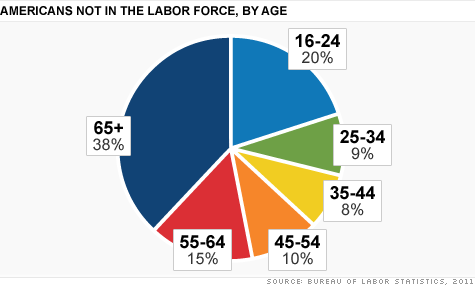
Last year, 86 million Americans were not counted in the labor force because they didn't keep up a regular job search. Most of them were either under age 25 or over age 65.Last year, 86 million Americans were not counted in the labor force because they didn’t keep up a regular job search. Most of them were either under age 25 or over age 65.

NEW YORK (CNNMoney) — There are far more jobless people in the United States than you might think.

While it’s true that the unemployment rate is falling, that doesn’t include the millions of nonworking adults who aren’t even looking for a job anymore. And hiring isn’t strong enough to keep up with population growth.

As a result, the labor force is now at its smallest size since the 1980s when compared to the broader working age population.

“We’ve been getting some job growth and it’s been significant, but it hasn’t yet been strong enough that you start to get people re-engaging in the labor market,” said Keith Hall, a senior research fellow at the Mercatus Center and former commissioner of the Bureau of Labor Statistics.

A person is counted as part of the labor force if they have a job or have looked for one in the last four weeks. As of April, only 63.6% of Americansover the age of 16 fell into that category, according to the Labor Department. That’s the lowest labor force participation rate since 1981.

It’s a worrisome sign for the economy and partly explains why theunemployment rate has been falling recently. Only people looking for work are considered officially unemployed.

Jason Everett, for example, wouldn’t be counted.

Out of work for nearly three years now, Everett has given up his job search altogether.

Instead, the unemployed plumber and Air Force veteran takes a few community college courses and looks after his two children while his wife is the primary breadwinner.

“I’m not even totally convinced the college degree is really going to help at this point, but I figure at least I’ll be doing something,” he said.

The unofficially unemployed

Last year there were 86 million people who didn’t have a job and weren’t consistently looking for one, according to Labor Department data.

Older people, ages 65 and over, account for more than a third. Young people between 16 and 24 make up another fifth. More than half don’t have a college degree and more than two thirds are white.

Many of the teens and 20-somethings may be enrolled in either high school or college full-time. And many of the over 65 crowd are probably retired.

But what about the other 36 million folks who fall in between?

The truth is, the Labor Department simply doesn’t know why they’re not in the labor force. Many may be staying home with children or other relatives. Some may have gone back to school or retraining programs. Others could be disabled and unable to work, and some may have retired early.

“Even in the best of times, there are millions of people who don’t want to work for a variety for reasons,” Hall said.

But he suspects the number of “disengaged” Americans, like Everett, is higher than usual as a direct result of the recession.

About six million people claim they want a job, even though they haven’t looked for one in the last four weeks. If they were to all start applying for work again, the unemployment rate would suddenly shoot up above 11%.

“At this point, the labor market is worse than people realize because people are discouraged. Certainly, a large number of workers have given up on the job market,” Hall said.

That said, the decline in labor force participation is not a new problem. After peaking at 67.3% in early 2000, the rate has been falling ever since.

Researchers at the Chicago Federal Reserve attribute a large part of the decline to the recent recession and lackluster recovery, but the other half to long-term demographic trends.

For example, as more women entered the labor force between the 1960s and 1990s, the participation rate rose rapidly. That effect may have plateaued since then.

Meanwhile, as Baby Boomers entered their prime working years, they also drove the participation rate higher. Once they started hitting their 50s and 60s though, many started transitioning into retirement.

Finally, teenage jobs have been on the decline and college enrollment picked up in the last decade, leading more young people to not be counted in the labor force.

As these trends continue, the Chicago Fed expects the labor force participation rate will keep falling, hitting 62.4% by 2020.

That poses a problem for a variety of reasons.

It hits tax revenue and makes it harder to fund social safety nets like Social Security. Not to mention, it’s likely to increase income inequality.

Most importantly though, it makes the U.S. economy less productive andweighs on growthTo top of page